
Network Protocols and Communications
RULES OF COMMUNICATION
| Message ⋙ | Signal ⋙ | The Channel ⋙ | Signal ⋙ | Message | ||||||
| Source | Encoder | Transmitter | Transmission Medium | Receiver | Decoder | Destination | ||||
| Message Encoding | ||||||||||
| OVERVIEW OF THE SEGMENTING PROCESS | |
| The size restrictions of frames require the source host to break a long message into individual pieces (or segments) that meet both the minimum and maximum size requirements | |
| Each segment is encapsulated in a separate frame with the address information, and is sent over the network | |
| At the receiving host, the messages are de-encapsulated and put back together to be processed and interpreted | |
| BENEFITS | DRAW-BACKS |
|
|
| MESSAGE DELIVERY OPTIONS | MESSAGE TIMING | ||
| Unicast | One Recipient | • Access Method | |
| Multicast | Multiple Recipients | • Flow Control | |
| Broadcast | All Recipients | • Response Timeout | |
NETWORK PROTOCOLS AND STANDARDS
| NETWORK PROTOCOLS |
| • How the message is formatted or structured |
| • The process by which networking devices share information about pathways with other networks |
| • How and when error and system messages are passed between devices |
| • The setup and termination of data transfer sessions |
| INTERACTION OF PROTOCOLS | ||
| • Application Protocol | Hyper Text Transfer Protocol | HTTP |
| • Transport Protocol | Transmission Control Protocol | TCP |
| • Internet Protocol | Internet Protocol | IP |
| • Network Access Protocols | Data link & physical layers | |
| CREATION OF INTERNET, DEVELOPMENT OF TCP/IP |
| The first packet switching network and predecessor to today's Internet was the Advanced Research Projects Agency Network (ARPANET), which came to life in 1969 by connecting mainframe computers at four locations |
| ARPANET was funded by the U.S. Department of Defence for use by universities and research laboratories. Bolt, Beranekand Newman (BBN) was the contractor that did much of the initial development of the ARPANET, including creating the first router known as an Interface Message Processor (IMP) |
| In 1973, Robert Kahn and Vinton Cerf began work on TCP to develop the next generation of the ARPANET. TCP was designed to replace ARPANET's current Network Control Program (NCP) |
| In 1978, TCP was divided into two protocols: TCP and IP. Later, other protocols were added to the TCP/IP suite of protocols including Telnet, FTP, DNS, and many others |
Protocol Suites and Industry Standards
| TCP/IP | ISO | AppleTalk | Novell Netware |
| HTTP DNS DHCP FTP | ACSE ROSE TRSE SESE | AFP | NDS |
| TCP UDP | TP0 TP1 TP2 TP3 TP4 | ATP AEP NBP RTMP | SPX |
| IPv4 IPv6 ICMPv4 ICMPv6 | CONP/CMNS CLNP/CLNS | AARP | IPX |
| Ethernet PPP Frame Relay ATM WLAN | |||
| SUMMURY |
| The TCP/IP network access layer is the equivalent of the OSI data link layer (Layer 2) and the physical layer (Layer 1) |
| The OSI physical layer provides the means to transport the bits that make up a data link layer frame across the network media |
| Physical layer standards address three functional areas: physical components, frame encoding technique, and signalling method |
| Using the proper media is an important part of network communications. Without the proper physical connection, either wired or wireless, communications between any two devices will not occur |
| Wired communication consists of copper media and fibre cable |
| There are three main types of copper media used in networking: unshielded-twisted pair (UTP), shielded-twisted pair (STP), and coaxial cable. UTP cabling is the most common copper networking media |
| Optical fibre cable has become very popular for interconnecting infrastructure network devices. It permits the transmission of data over longer distances and at higher bandwidths (data rates) than any other networking media |
| Wireless media carry electromagnetic signals that represent the binary digits of data communications using radio or microwave frequencies |
TCP/IP Protocol Suite and Communication
| APPLICATION LAYER |
| ||||||||||||||
| represents data to the user, plus encoding and dialog control | |||||||||||||||
| TRANSPORT Layer |
| ||||||||||||||
| supports communication between diverse devices across diverse networks | |||||||||||||||
| INTERNET LAYER |
| ||||||||||||||
| determines the best path through the network | |||||||||||||||
| NETWORK ACCESS LAYER |
| ||||||||||||||
| controls the hardware devices and media that the network | |||||||||||||||
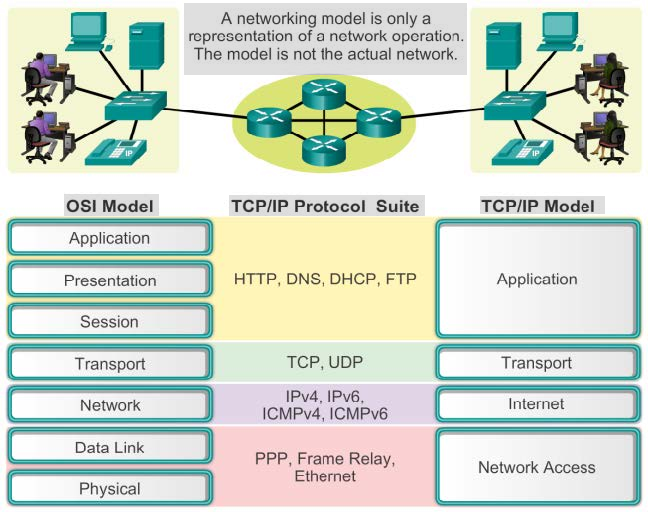 |
| The key parallels are in the transport and network layer |
| OSI MODEL | |||||
| # | LAYER | DESCRIPTION | PDU | PROTOCOLS | |
| 7 | Application | H | Network process to application | Data | DNS, WWW/HTTP,P2P, EMAIL/POP, SMTP, Telnet, FTP recognizing data |
| 6 | Presentation | H | Data representation and encryption | Data | HTML, DOC, JPEG, MP3, AVI |
| 5 | Session | H | Inter host communication | Data | Sockets, Session establishment in TCP, SIP, RTP RPC - Named pipes. |
| 4 | Transport | H | End-to-end connections and reliability | Segments | TCP, UDP, SCTP, SSL, TLS |
| 3 | Network | M | Path determination and logical addressing | Packets | IP, IPsec, ICMP, IGMP, OSPF,DHCP |
| 2 | Data Link | M | Destination and Source Physical addressing | Frames | Ethernet, PPP, 802.11, MAC/LLC, VLAN, ATM, HDP, Fibre Channel Frame Relay, HDLC |
| 1 | Physical | M | Media signal and binary transmission | Bits | Q.921, Token Ring, ARP, RS-232, RJ45, V.34, 100BASE-TZ, SDH, DSL, 802.11 |
• H : Host Layers • M : Media Layers | |||||
Standards Organizations
 |
| OPEN STANDARDS | PHYSICAL LAYER | |
| The Internet Society | ISCO | IAB |
| The Internet Architecture Board | IAB | IETF, IRTF |
| The Internet Engineering Task Force | IETF | IESG |
| Institute of Electrical and Electronics Engineers | IEEE |
|
| The International Organization for Standards | ISO |
|
| The Telecommunications Industry Association | TIA |
|
| The Electronic Industries Alliance | EIA | |
| International Telecommunications Union-Telecommunications Standardization Sector | ITU-T |
|
| The Internet Corporation for Assigned Names and Numbers | ICANN | |
| The Internet Assigned Numbers Authority | IANA | |
| American National Standards Institution | ANSI |
|